2026 Apr 25 19:59
Integrated Smart Shading & Photovoltaic Ecosystem: A LUMEL Approach to Dynamic Energy Management
Lumel: A Paradigm Shift in Adaptive, Power-Generating Building Envelopes
The modern high-rise, traditionally a structure of concrete, steel, and glass, is undergoing a profound energy transformation. As urbanization accelerates and climate concerns intensify, buildings must evolve from passive energy consumers into active participants in a green grid. Current strategies, such as simple low-E coatings or passive horizontal louvers, have reached their performance limits. Low-E coatings, while helpful, reduce natural light and cannot adapt to changing daily conditions, often requiring excessive artificial lighting. Fixed louvers, too, are inefficient, either over-shading and plunging interiors into gloom on overcast days or under-shading, leading to significant solar heat gain and astronomical cooling costs. The industry has long awaited a technology that can dynamically manage the sun’s energy without compromise.
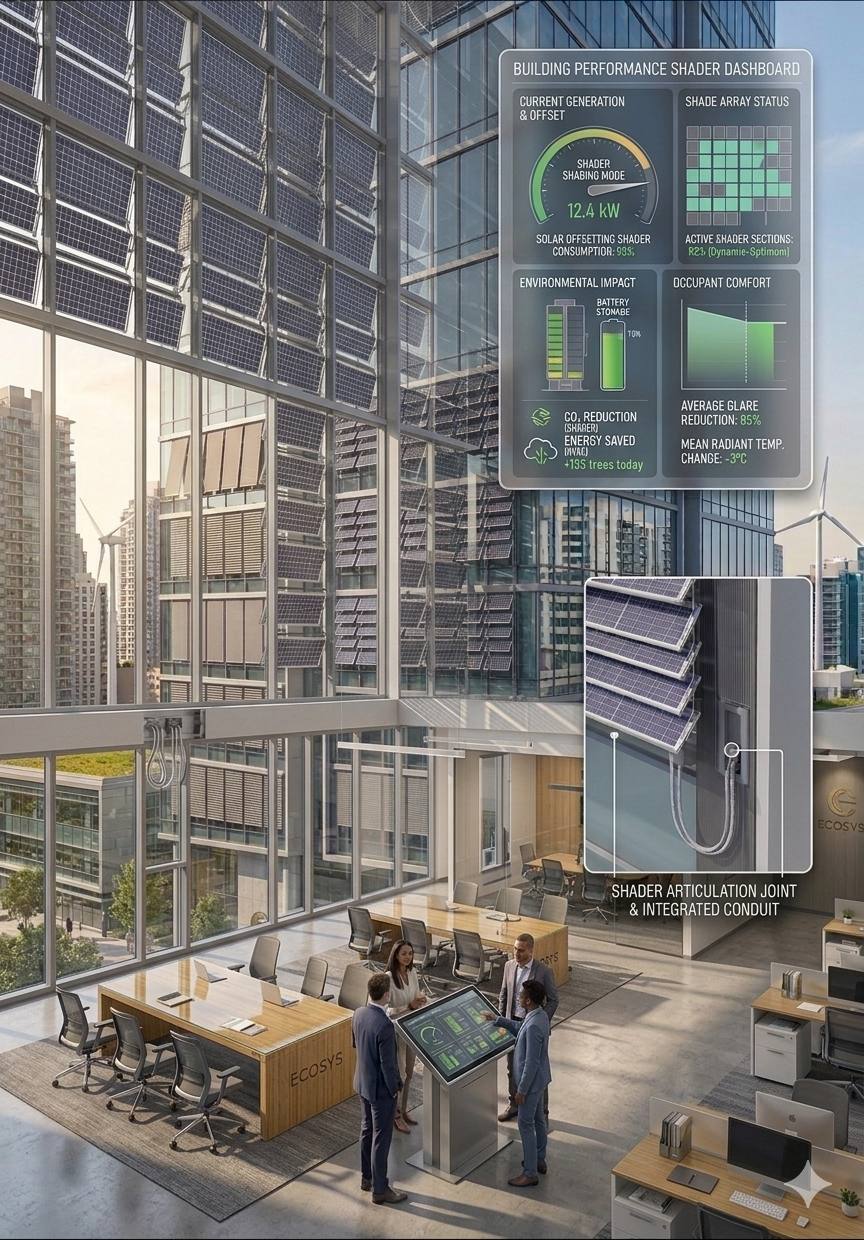
The solution has arrived in the form of Lumel technology. As visualized in the state-of-the-art office atrium of the ECOSYS building (Image 0), Lumel is not just a building component; it is a holistic, adaptive energy and comfort ecosystem. It is a revolutionary facade system that replaces traditional passive shading devices with hyper-intelligent, motor-driven, micro-photovoltaic panels. The brilliance of Lumel lies in its core innovation: the solar shading arrays are not static. Integrated with precise "Shader Articulation Joints," each louver is an articulated solar panel that can dynamically track the sun's path across the sky with robotic precision. This dual-purpose design allows the panels to pivot, optimizing their angle for maximum power generation when deployed and, critically, retracting when they would otherwise obstruct daylight or become redundant.
To harness solar radiation effectively, the solar shader acts as a dual-purpose solution for buildings. On one hand, it dynamically manages daylight and thermal gain by deploying or retracting based on sun intensity, which significantly reduces the energy required for cooling. More importantly, when combined with integrated photovoltaic (PV) technology—as shown in the schematic with facade-mounted solar panels—this "shading" system can be considered part of a larger, actively managed solar harvesting setup, in which the shades complement a holistic, building-wide power generation strategy.
The LUMEL-based motor control allows this shading to be hyper-intelligent. It doesn't just block heat; it is an active participant in an automated daylight and energy management system. By using smart scheduling and sensor feedback (integrated via the "LUMEL" app and building hub), the shades optimize the environment, reducing grid dependency. In a complete installation, the smart shades contribute to overall building energy efficiency by minimizing passive solar heating loads, freeing up energy generated by the associated solar panels for other critical building loads, thereby maximizing the net energy production of the building ecosystem.


